- Home
- Chinese Culture
- How to be Lucky in China
How to be Lucky in China
The Chinese people have worked out that certain things – numbers, colours, animals, days, and actions – are more auspicious than others.
“Auspicious” means:
- promising success; propitious; opportune; favourable: an auspicious occasion.
- favoured by fortune; prosperous; fortunate.
Put simply, it means that there are certain things that can bring good – or bad – luck.
Whether you agree with it or not, it is good to know how to please your Chinese friends, and how to make sure that you do not risk offence by appearing to cause them misfortune as you socialise with them.
Many symbols of Chinese Good Luck come from words that sound the same as, or similar to, others. Chinese people love word play!
Chinese Lucky Numbers
No one will expect you to know and understand all of the intricacies of lucky numbers, but it is best to be wise to the most obvious ones.
Lucky Number 8

The best number is 8, simply because its name, “ba”, sounds similar to the word “fa” which means “to make a fortune”. If you can manage to be born on a day with an 8 in it, or live in a dwelling at number 8, or have a phone number with multiple 8s, then you are bound to be lucky.
Phone numbers with 8s are more expensive, especially if there are a lot of 8s. House or apartment numbers that contain 8 are very popular. And, of course, the Olympics in Beijing started on 2008 – 08 – 08. (Chinese dates are written in this order: year – month – day.)
Other lucky numbers
Of course there are other lucky numbers because everybody likes to be lucky.
- 2, “er”, because good things come in pairs
- 3, “san”, because it sounds similar to “birth”
- 5, “wu”, because it’s associated with the five elements in philosophy
- 6, “liu”, because it’s good for business as it sounds similar to “fluid”
- 7, “qi”, because it’s good for relationships as it symbolises togetherness
- 9, “jiu”, because it sounds like “long-lasting” and was historically associated with the Emperor
So that is pretty much everything except 4!
Chinese Unlucky Numbers
Unlucky number 4 - Why is 4 unlucky?

The worst number is 4, because its name, “si”, sounds very similar to the name for death. So phone numbers without a 4 can be more expensive, and apartments on the 4th floor (if there is one) are unpopular. This is very much like number 13 in Western society.
Combinations to change your luck
Number 5, “wu”, can also be unlucky, as it is usually associated with “not” – but this can turn around to be good in a combination such as 54 meaning “not dead”.
Pairs, multiples and even numbers are preferred to odd numbers. So, for example, if you want to buy your friend a gift of fruit, 6 apples would be better than 5 – of course, 8 would be better still!
Combinations can also increase the auspiciousness of numbers. For example, 28 gives “double luck”, and 38 can be “triple luck”. There are many other complicated combinations that you could only understand if you knew the language.
Chinese Lucky Colors
Not surprisingly it is very important to dress in the right colors, and decorate with auspicious colors.
Red
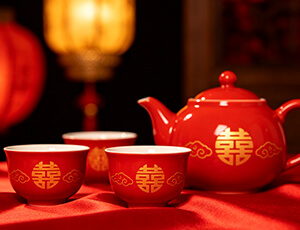
Can you guess the Chinese national color? Red, of course! The color symbolises fortune, success, beauty, happiness, celebration … and it’s just a really nice color. Weddings are celebrated in red, and gifts of money are given in bright red envelopes – such as at Chinese New Year.
Yellow
Along with the red, you will notice a lot of the colour yellow. Red and yellow are often seen together, with the yellow giving the appearance of gold. The colour yellow was very much a symbol of the emperors of China as it was used in their royal clothing and to decorate palaces, altars and temples. It is also a very important colour for the Buddhists, representing freedom from worldly concerns. It is the colour of heroism, rather than cowardice as in Western culture. (However, it can also refer to pornography when the police are doing a raid.)
Unlucky Colors
White
The color white is used for funerals, and is associated with death. Never wrap a gift in white paper, or bring white flowers except to a funeral.
Black
Black is also not good, indicating solemness, formality, and evil. Black borders around a photo indicate that the person pictured is dead.
Green
As a less obvious one, the color green has different connotations and meanings from Western culture, though not especially bad or good, and a slightly unexpected meaning in that a man wearing a green hat indicates that his wife or girlfriend is cheating on him.
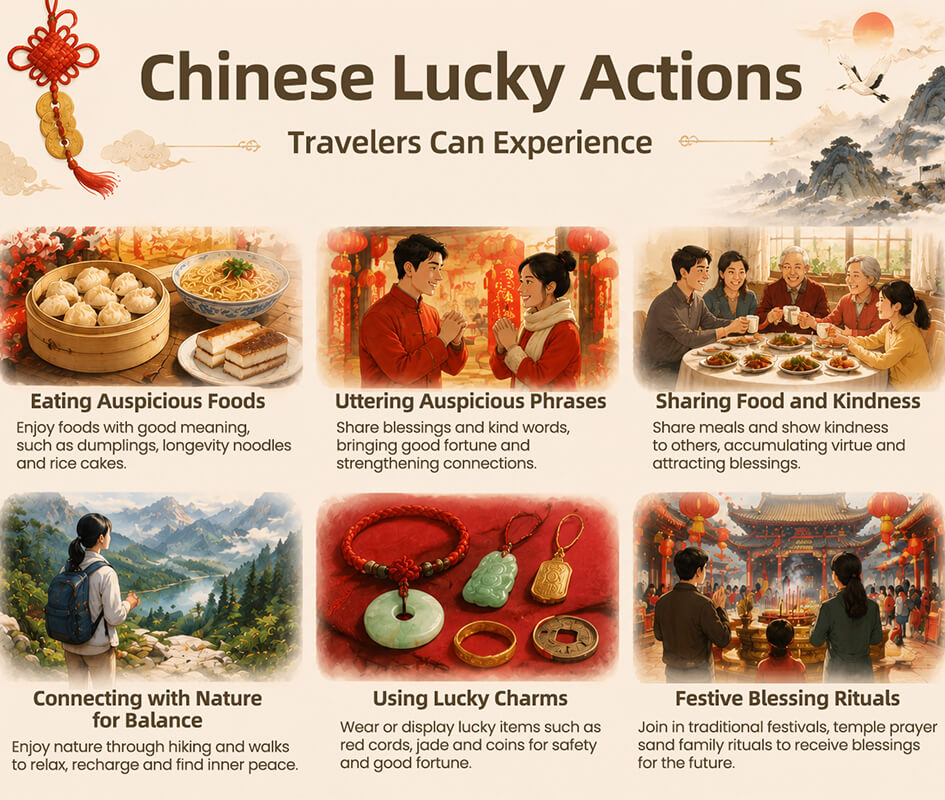
Chinese Lucky Actions Travelers Can Experience
In China, many people express their hopes for good fortune through traditional customs and positive lifestyles.
Eating Auspicious Foods
In daily life and during traditional festivals, people favour food items with favourable symbolic meanings. Dumplings resemble ancient gold ingots and therefore symbolise wealth; longevity noodles eaten on birthdays stand for health and a long life; rice cakes carry the implication of “steady progress in life”.
Uttering Auspicious Phrases
Chinese culture values positive verbal expressions. Especially during festivals such as the Spring Festival, people exchange blessings including “Wishing you prosperity”, “Wishing you good health” and “May all your wishes come true”. Offering compliments and good wishes in daily interactions also serves as a way to strengthen interpersonal bonds.
Sharing Food and Kindness
Sharing delicious food with family and friends is believed to nurture relationships and build good social connections. Acts of kindness such as helping others and taking part in volunteer work embody the cultural concept of “accumulating virtue to draw blessings”.
Connecting with Nature for Balance
When feeling stressed or worn-out, many people unwind by mountain-hiking, taking walks or visiting natural scenery. In traditional Chinese culture, nature is thought to bring inner peace and positive energy.
Using Lucky Charms
Some people wear or display items with auspicious connotations, such as red cords, safety pendants, jade ornaments, gold jewellery and ancient copper coins, in the hope of securing safety and good fortune.
Festive Blessing Rituals
During traditional festivals including the Spring Festival and Mid-Autumn Festival, people convey best wishes for the future through New-Year greetings, ancestor worship and temple prayers. For visitors, joining these festive activities offers a valuable experience for understanding Chinese culture.
Chinese Unlucky Customs Travelers Should Know
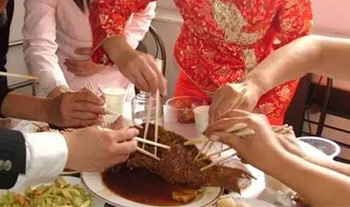 Do not flip a whole fish
When travelling in China, visitors may encounter customs associated with auspicious symbolism and traditional beliefs. Understanding these cultural connotations helps travellers better respect local culture and enjoy an enhanced travel experience.
- Do not flip a whole fish: When eating a whole cooked fish, people in some regions avoid turning the fish over. This act symbolises a capsized boat, which is seen as an ill-omen for fishermen.
- Do not cut a pear to share with others: Since the phrase "sharing a pear" sounds identical to "separation" in Chinese, many believe cutting a pear for shared consumption signifies parting.
- Do not stick chopsticks upright in rice: Chopsticks standing vertically in a bowl of rice resemble incense sticks used in sacrificial rituals, making this an inappropriate table manner.
- Gift-giving etiquette: Clocks and umbrellas are generally avoided as gifts in traditional culture. The Chinese word for "clock" is homophonous with "end", and the word for "umbrella" sounds like "separation", both carrying inauspicious associations. Tea, handicrafts and local souvenirs are generally more suitable alternatives.
- Birthday customs: Longevity noodles are served for Chinese birthdays, symbolising long life and good health. Traditionally, the noodles are not cut, as unbroken long strands represent a long lifespan.
- Whistling at night: Some folk beliefs hold that whistling after dark may attract unwelcome spirits, so this practice is commonly avoided.
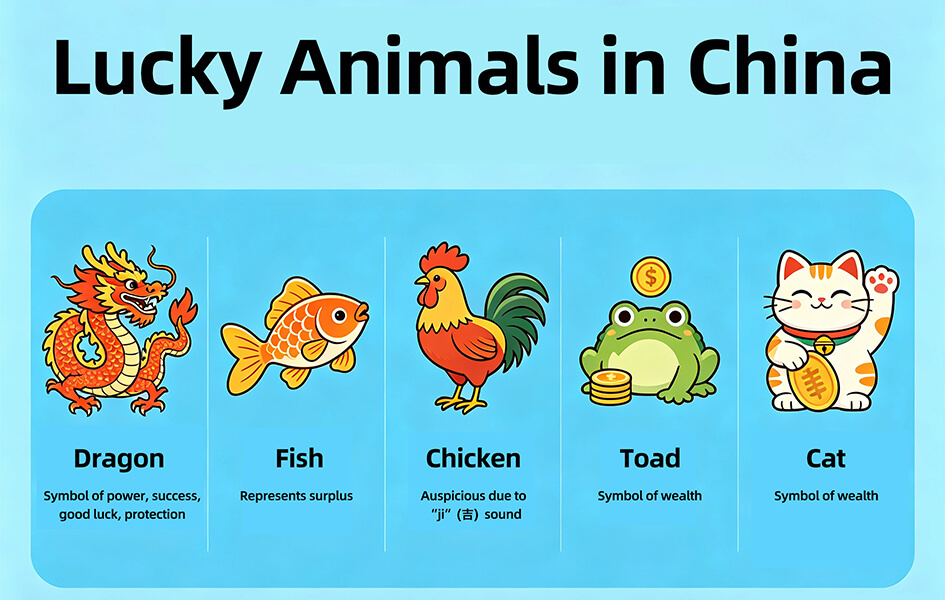
Lucky Animals in China
There are a number of symbols of good luck that you will notice everywhere in China. These are the most obvious and common ones:
Dragon
The dragon is one of the most representative symbols of good fortune in Chinese culture. It represents power, success, good luck and protection. In traditional Chinese beliefs, dragons were believed to control rain and weather, bringing prosperity and a good harvest. Click here to learn more about Chinese dragon culture.
In China, dragon motifs can be found in everyday life, including clothing, jewelry, ceramics, jade ornaments, tea sets and festival decorations. When traveling in China, visitors can explore places such as the Forbidden City and the Nine-Dragon Wall in Datong to discover dragon images in architecture and art, and experience how dragon culture continues to influence Chinese traditions and modern life.
Fish
The word for fish, “yu”, is the same as the word for surplus, and so you will see depictions of fish as symbols in many businesses.
Chicken
Both chicken and lucky are pronounced “ji”, making this creature auspicious and depicted in many places.
Toad
You will often see a toad on the counter in a restaurant, store or hotel. With its seat of coins, it is a symbol of wealth and money-making.
Cat
This symbol of wealth, endlessly waving a paw across its face, originated in Japan, but can be seen all over China. There is a Chinese folk belief that when a cat washes its face, guests will arrive.
Lucky Culture in Chinese New Year and Chinese Zodiac
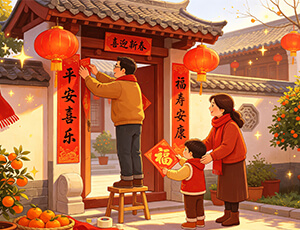
Chinese New Year is celebrated all over the world in Chinese communities, Chinatowns, and among people everywhere who are fascinated by Asia. As you prepare to take your trip to China, it’s a good idea to look up the details of your birth year, and Good Luck as it applies to you from the Chinese perspective, and people you meet will appreciate you taking an interest.
The Chinese zodiac follows a cycle of 12 animals. In order they are: Rat, Ox, Tiger, Rabbit, Dragon, Snake, Horse, Goat, Monkey, Rooster, Dog, Pig. The year 2015 is the year of the Goat, so you can work backwards to find your year, or find an online calendar, and even look up how the year of your birth is supposed to affect your character. You can find out more on this page.
Have an Auspicious Visit to China
For the sake of making new friends, showing respect, and having a memorable visit to China, it is worth being mindful of what is considered auspicious, and what is not.
The best way to understand China’s auspicious culture is through hands-on experience within real-life travel scenarios. While travelling across China, students and visitors can observe how auspicious symbols are woven into everyday Chinese life by visiting temples, participating in traditional festivals, exploring historic buildings and wandering through local markets.
China Educational Tours can custom-design cultural-experience itineraries to suit diverse requirements, enabling travellers to learn about traditional Chinese customs, cultural symbolism, and people’s sincere wishes for happiness, health and good fortune through immersive travel.
 Chinese Operas
 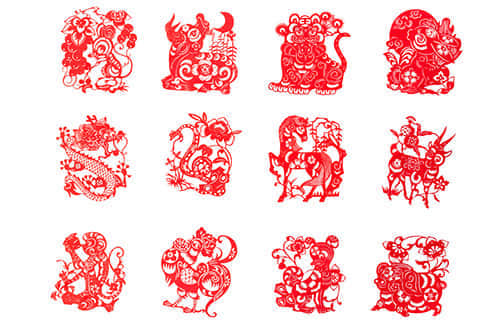 Chinese Zodiac
  Chinese Kung Fu
  Confucianism