- Home
- City Tours
- Xiamen Tours
- 5-Day Fujian School Tour

Fujian School Tour for Sustainable Learning
Itinerary at a Glance
| Day | Location | Highlights |
|---|---|---|
| D1 | Xiamen (Hotel - Bashi Market) | check into Hotel; join "Amazing Race" at Bashi Market to explore local produce |
| D2 | Xiamen - Zhangzhou | Check out and transfer to Zhangzhou; visit high-tech farm; students present on "future of sustainable farming"; join Farm-to-Table cooking |
| D3 | Tulou Area | Go on Tulou cycling tour; interview local farmers about rural life; experience tea picking and tasting |
| D4 | Tulou Area | Participate in Tulou restoration service project; hold BBQ celebration dinner and party at Tulou |
| D5 | Tulou - Xiamen | Check out and transfer back to Xiamen; trip ends |
Trip Highlights
- Visit high-tech farm and talk to owners/employees to understand how technology can help make farming more sustainable
- Participate in Farm-to-Table Cooking at the farm
- Interview local farmers on daily life in rural Fujian
- Learn tulou restoration techniques
Tour Essentials

Quality
No Shopping Traps

Group Type
Private

Tour Focus
Educational Experiences

Accommodation
Nights:4

Best Season
Spring, Summer, Autumn, Winter
Full itinerary for Fujian School Tour for Sustainable Learning
After arriving in Xiamen, proceed to the hotel to complete the check-in procedure. Take a short rest to recharge energy for the subsequent itinerary.
Gather in the afternoon and depart for the Bashi Vegetable Market (also known as "No. 8 Vegetable Market"). With a long history, Bashi Vegetable Market is the largest marketplace for daily life in Xiamen. Here, students can get to know a variety of agricultural products grown in Xiamen, and also communicate with local residents to learn about the cooking methods of different agricultural products. Afterwards, students will participate in the "Amazing Race" activity — through a fun competition format, they will explore the types of agricultural products sold in Bashi Vegetable Market and their origin locations, thereby increasing their knowledge of agricultural products during the game.
 Students are Visiting the 8th Market
Your Journey’s Rewards:
By conducting an in-depth exploration of Xiamen Bashi Vegetable Market, students will learn about the types of local agricultural products, trace their origin places and circulation routes, and perceive the connection between traditional marketplaces and agricultural production.
Educational Focus:
What are the main agricultural products in Xiamen?
Takeaway:
Xiamen has a subtropical marine monsoon climate, characterized by warmth and humidity, which is suitable for growing a variety of crops that prefer warm and humid environments and are tolerant of heat and moisture; common agricultural products in the city include fruits like longan, fragrant lemon, dragon fruit, grape, pineapple and watermelon, vegetables such as green onion and purple long eggplant, and tea represented by high-mountain oolong tea.
Thought Challenge:
Against the background of the rapid development of modern supermarkets and e-commerce fresh food platforms, what unique values do traditional farmers' markets like Xiamen Bashi Vegetable Market have in inheriting Minnan (Southern Fujian) agricultural culture and serving the daily life of local people?
Students will visit the Yuanxing Ecological Aerospace Vegetable Exhibition Hall, where they can get to know and understand the planting methods of aerospace vegetables. They will also learn about Yuanxing's ecological agricultural planting model — soilless cultivation technology, and get to know hydroponics and substrate cultivation, while thinking about the advantages and disadvantages of these two techniques. Through the farm visit, students will gain a preliminary understanding of the development of modern agriculture. Afterwards, they will communicate with the farm's technical staff to learn how technology helps agriculture achieve more sustainable development.
After lunch, students will conduct a special presentation titled "The Future Development of Sustainable Agriculture" in the meeting room. Combining the intelligent planting and organic cultivation technologies observed at Yuanxing Farm in the morning, as well as their previous understanding of Xiamen's agriculture, students will put forward their own suggestions on "The Future Development of Sustainable Agriculture". Next, students will experience rural life firsthand: they can pick ingredients in the designated areas of the farm, then cook dinner with their own hands, participate in the "Market & Farm-to-Table MasterChef" competition, and taste the fruits of their labor together with their partners.
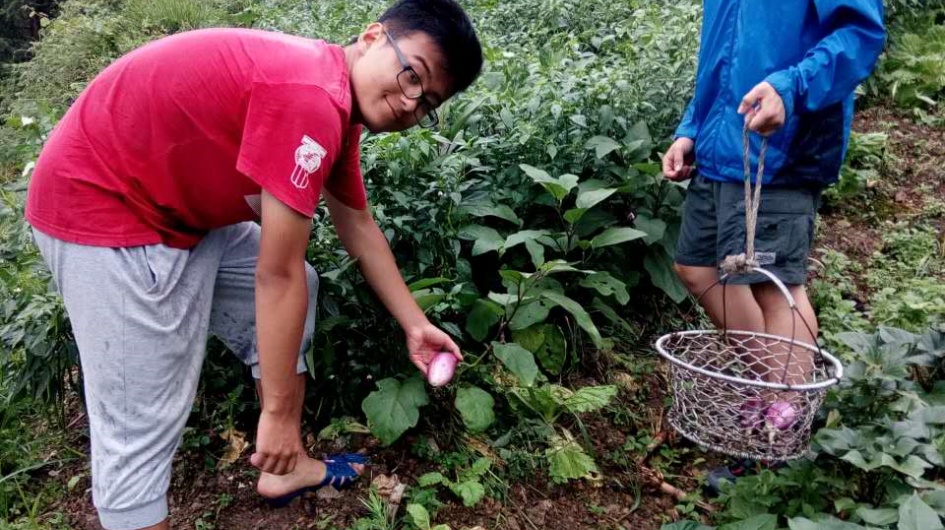 Students Picking Vegetables
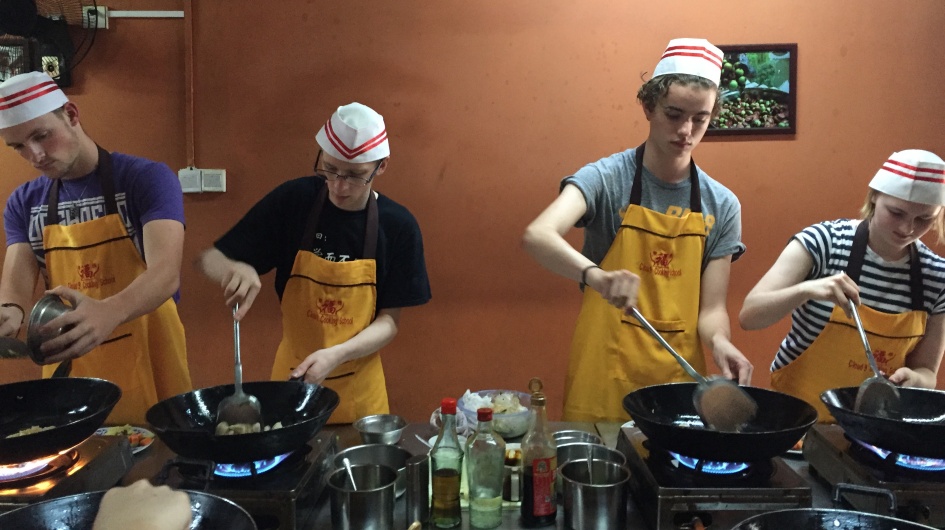 Students Experiencing Making Farmhouse Dishes
Your Journey’s Rewards:
By visiting the local farm, students understand and learn about soilless cultivation technology. Through communication with the farm's technical staff, they gain an understanding of how technology helps agriculture achieve more sustainable development.
Educational Focus:
What are the advantages of soilless cultivation?
Takeaway:
Since soilless cultivation uses nutrient solutions, it can accurately control the conditions such as nutrients, water, and temperature required by plants. Therefore, the growth rate and yield of plants under soilless cultivation are often higher than those under conventional cultivation. Soilless cultivation can be carried out inside buildings or in limited spaces in cities, thus saving land resources. Secondly, the medium used in soilless cultivation is disinfected, so the incidence of diseases and pests is relatively low, and plants have stronger disease resistance. Most importantly, the waste from soilless cultivation can be recycled — for example, nutrient solutions can be recovered and reused, thereby reducing the impact on the environment.
Thought Challenge:
How should Yuanxing Farm optimize its operation model so that it can not only continue to play an exemplary role in "empowering organic agriculture with technology" but also make organic agricultural products more accessible to the mass consumer market?
After breakfast, students will start a half-day Tulou cycling experience. First, listen to the tour guide explain the cycling route and precautions, then set off on the ride. The first stop is the Tianluokeng Tulou Cluster. Stay here to observe the distribution of farmland around the Tulou and the types of crops grown on different land types. If you happen to encounter farmers working in the fields, you can talk with them to learn about farming techniques and the optimal planting times for different crops.
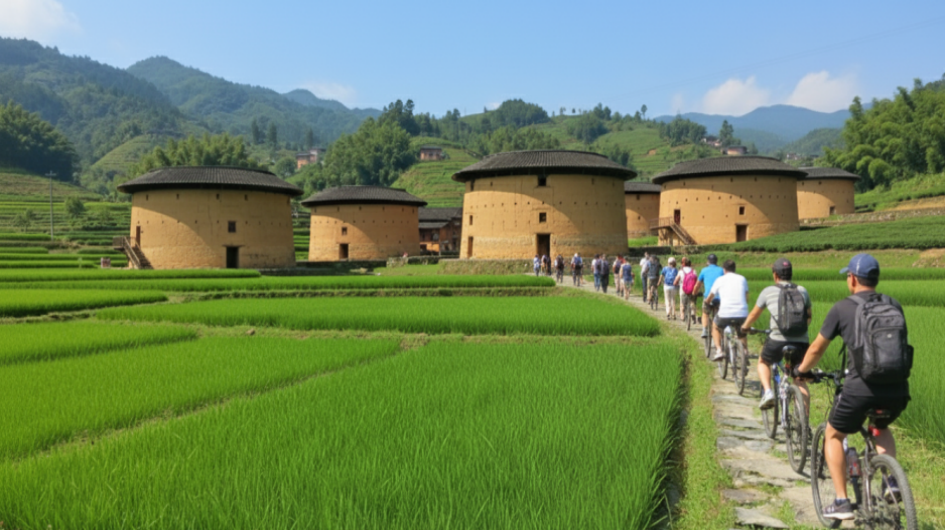 Tulou Cycling Tour
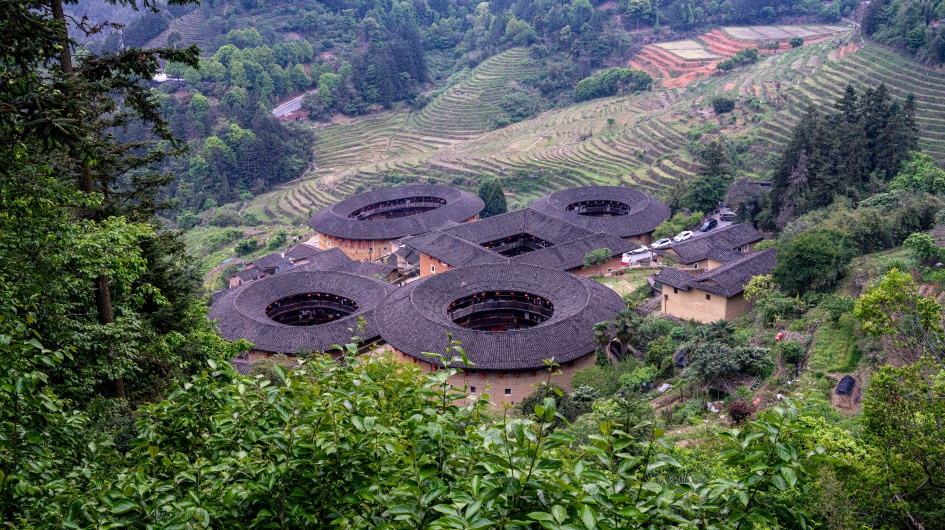 Tianluokeng Tulou Cluster
 Visiting the Interior of Tulou
After lunch, students will visit local farmers' homes for home visits and exchanges to gain an in-depth understanding of the local farming life. At the residents' homes, you can visit the internal structure of the Tulou and learn about the architectural wisdom behind this distinctive building. Then, visit the residents' vegetable gardens and farm tool rooms to understand crop planting techniques and learn to use different farm tools. Communicate with the residents to learn how to control pests, apply fertilizers to crops, and protect crops during severe weather.
Next, students will participate in a tea-picking experience. Head to the local tea garden, and under the guidance of tea farmers, learn tea-picking techniques. You can also take part in tea processing and learn the core procedures of tea production. Finally, sit around with your partners to taste the tea, and listen to the tea farmers share Nanjing's tea culture and the life philosophy related to tea tasting.
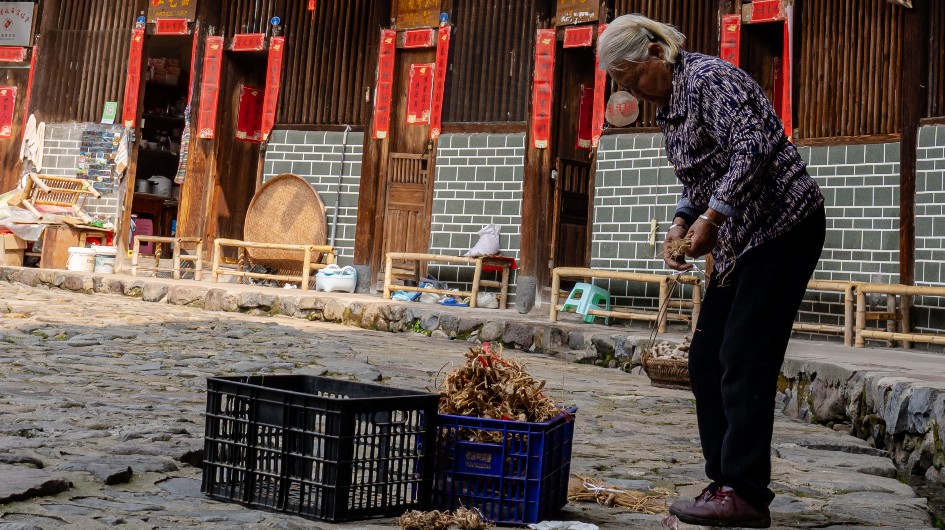 Visit Local Farmers' Homes
Your Journey’s Rewards:
Through home visits to farmers' families, students learn crop planting techniques and how to use various farm tools. By communicating with residents, they acquire knowledge on crop pest control, fertilization methods, and ways to protect crops in severe weather. Through personal participation in tea-picking and tea-tasting experiences, they gain an understanding of Nanjing's tea culture.
Educational Focus:
How to protect crops during heavy rain?
Takeaway:
First, it is necessary to dredge the ditches to drain stagnant water. After heavy wind and rain, promptly dredge the drainage systems in and around the vegetable fields to ensure the normal growth of crop roots. Then, timely tie up and support the lodging vegetable plants, reinforce the vegetable racks, clean the sediment attached to the stems and leaves, and conduct centralized harmless treatment of the sediment to cut off the transmission route of diseases and pests and reduce repeated infections. After the weather stabilizes, timely loosen the soil and apply a small amount of quick-acting fertilizer to promote root growth and development and help the vegetables recover their growth.
Thought Challenge:
What are the key preventive measures against bacterial diseases in crops?
In the morning, students will participate in a volunteer service project — the Tulou Restoration Practice. Teachers responsible for Tulou protection in the local area will lead students to have an in-depth tour of the Tulou, enabling them to fully understand the Tulou's structure, architectural features, and rammed earth characteristics. Students will also make Tulou models to learn about specific restoration methods. Afterwards, they need to prepare restoration materials together with the teachers, learn traditional craftsmanship techniques, and work with many peers to complete the Tulou restoration task through relay cooperation.
After lunch, students will continue the Tulou restoration work, finish the corresponding finalization tasks, pack up tools, and clean the site. After the restoration work, if time permits, students can also visit the Tulou. During the visit, they can play games in the fields, learn to cook Hakka cuisines with local Hakkas to gain an in-depth understanding of the rural life here; alternatively, they can discuss the inheritance and protection plans of the Tulou cultural heritage with local residents, contributing significantly to the protection of Tulou culture. In the evening, students will hold a BBQ celebration dinner and party at the Tulou.
Your Journey’s Rewards:
Through the Tulou restoration practice, students have a comprehensive understanding of the Tulou's structure, architectural features, and rammed earth characteristics. They make Tulou models, learn traditional craftsmanship techniques, and complete the Tulou restoration task through relay cooperation with many peers. Meanwhile, this experience enhances students' teamwork ability.
Educational Focus:
What functions do Tulou buildings have?
Takeaway:
A Tulou is like a small society, reflecting the landscape of Hakka society. It has comprehensive functions, including earthquake resistance, fire prevention, defense, and more. With good ventilation and lighting, it remains cool in summer and warm in winter. These advantages demonstrate the wisdom of the Hakkas, earning it the reputation of "the Gate-less Museum of Chinese Hakkas".
Thought Challenge:
In the context of contemporary society, how should civil engineering in the new era be applied to the protection of ancient buildings?
After getting up in the morning, have breakfast at the hotel. For the following time, students pack their own luggage, check out of the hotel after making sure nothing is left behind, and finally return to Xiamen Airport to complete the boarding procedures. This marks the end of the trip.
This tour is suitable for: Students, Teachers, Schools, Educational Groups, Families, Educational Travelers
What’s Included
- Experienced tour guides
- Entrance fee to all spots listed in the itinerary
- Well selected hotel accommodation
- Expert drivers and comfortable vehicles with air-conditioning
Hotel Options
- Xiamen Urban Area Hotel Accommodation: Xiamen Plaza
- Nanjing Hotel Accommodation: Yuchang Hotel; Tulou boutique hotel
Wechat & WhatsApp: +86-13471279378